
Where words are not enough.


Dreams of stone and a star-studded sky
From historic walls to wineries, from warm seas to a star-studded sky, southern Croatia offers adventures of all types.
The land of the Greek hero Odysseus, famous explorer Marco Polo, and a rich culture invites you to explore its incredible landscapes, fascinating legends, and stunning beauty.
Where words are not enough.
Start your journey through the area of the former Republic of Dubrovnik from its very core. Dubrovnik, one of the most dazzling cities in the world, is a rare example of indescribable beauty, spiritual greatness, and human strength.
1,940 meters of medieval walls outline people’s dreams of freedom, and a performance stage leads to the stars during the Dubrovnik Summer Festival or to the Iron Throne in Game of Thrones. When you arrive in the old town, which is protected by UNESCO, don't forget to shake the hand of the patron saint St. Blaise, who will show you the endless universe of life and thousands of years of history recorded there by works of art. Three of the five existing forts form an integral part of the Walls of Dubrovnik: Minčeta, Bokar, and St. John. The other two forts, Lovrijenac in the west and Revelin in the east, are not connected to the Walls. The main street (Stradun) is the perfect spot for absorbing the beauty of stone compositions beneath the stars, while the Sponza Palace, the Rector’s Palace, the Large and Small Onofrio's Fountains, the Church of St. Blaise, and Orlando’s Column will show you the side of the town that shall forever remain youthful. Explore a plethora of historical and natural sights by visiting museums, discover the green realm of the Trsteno Arboretum, and enjoy the panorama from the Srđ hill, which can be easily reached by cable car. Every view in Dubrovnik is limitless, every memory perfect, and every day seems too short.

Shaped out of sedimentary limestone rock and dolomites that made it a karst landscape full of caves, pits, ravines, ponds, brackish springs and fertile valleys, Lastovo Islands Nature Park includes 46 islands, islets, rocks and reefs. In addition to the southernmost Croatian inhabited island, Lastovo, the park also includes the island groups Lastovnjaci and Vrhovnjaci as well as the island of Sušac. More than 800 plant species have put down roots there, and the area is also inhabited by 175 bird species, while the fascinating underwater world adds to the blue depths that surround the park. Lastovo was declared a nature park in 2006. After World War II, it was an island reserved only for the military, and tourism began to develop after 1988, when the ban on visits by foreign nationals was lifted.
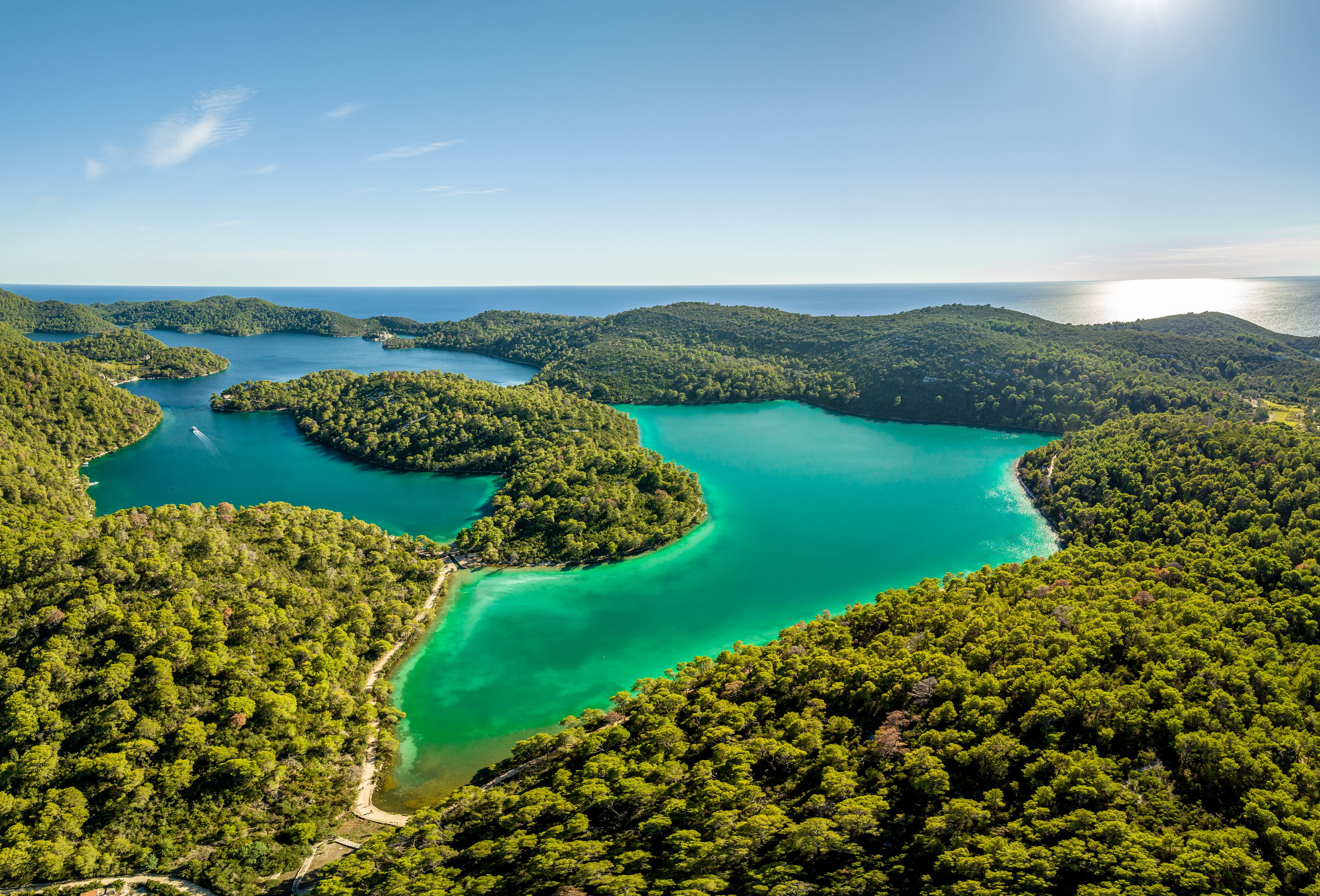
Being surrounded by pristine nature is a true privilege. As the oldest marine park in Croatia, Mljet National Park, nestled in the northwest part of the island, is a verdant sanctuary where lush forests and turquoise waters of the Great and Small Lakes (Croatian: Veliko and Malo Jezero) provide the perfect backdrop for an idyllic retreat. Unwind in the shade of the Benedictine monastery on the island of St Mary, venture along cycling and hiking paths, or simply revel in the beauty of the beaches. The greenest island of the Adriatic once entranced the ancient hero Odysseus, and it’s sure to cast a spell on you, too.

The view of the open blue seas will reveal all the splendour of the area’s islands, with one of them being only a 10-minute boat ride away from Dubrovnik.
Lokrum, also known as the island of lovers, the place of origin of the centuries-old legend of Richard the Lionheart, is an ideal getaway haven. A nature reserve with a garden full of exotic plants, a summer house, a small lake connected to the sea, and several idyllic beaches are the main ingredients for a perfect summer day.

The traveller in you might want to continue towards the open sea, where the Elaphites will be waiting for you.
Named Elaphite islands after the Latin word Elaphos for deer, this archipelago, which used to be the habitat of this noble wild game, concentrates all the qualities of the untouched Mediterranean, featuring subtropical vegetation, expansive pine tree forests and olive groves, all surrounded by amazing sandy beaches.They are a group of islands that were once a popular destination among the Dubrovnik nobility and are nowadays appreciated by all those who wish to experience the true Mediterranean. The three largest islands among them – Koločep, Lopud, and Šipan – exude romance with bays where pine trees nearly embrace the sea. On Lopud, you will find Šunj, the most popular beach in Dubrovnik’s waters, and on the largest island Šipan, the spirit of the Republic of Dubrovnik is the strongest. Šipanska luka and Suđurađ are two places that boast the harmony of lush vegetation and elegant architecture, consisting of as many as 42 old summer houses, 34 churches, and numerous chapels.


The remaining three inhabited islands in the southern Adriatic can almost be viewed as three separate continents. So different, yet so similar in their timeless beauty.
The farthest of the bunch is Lastovo, which forms the Lastovo Islands Nature Park with its 46 islands, islets, rocks, and reefs. It is a lonely offshore ship anchored under the stars, persevering against the strongest storms and the most violent waves. Isolated, wild, wooded, and fragrant. The dream of every true traveller. The largest settlement of Lastovo is tucked away in the interior of the island like a pearl in a shell. You will surely be amazed by the characteristic chimneys called fumari and the unique Lastovo carnival, which combines the carnival tradition with the celebration of the successful defence against pirates in the Middle Ages. Lastovo is also known for its magical evenings when the sky above it is studded with millions of stars.

Lastovo was called the imperial island by the Romans, while the neighbouring Mljet is known as Odysseus’ Island.
The Mljet National Park accounts for almost a third of the island’s surface area, and it comprises the Small and Large Lake with the islet of St. Mary, home to a Benedictine monastery. Mljet has no large settlements, and nature lovers will surely find the uninhabited southern part of the island, where an ancient hero was stranded in a shipwreck, particularly attractive. The sandy beaches of Saplunara and Limuni, as well as Odysseus’ Cave, will whisk you away to a new adventure.

Just as Mljet was made famous by Homer, Korčula is known as the island of Marco Polo, and its shores have been inhabited since prehistoric times.
The heritage of Korčula is written in stone and a magical labyrinth of streets built in the herringbone pattern will take you to elegant façades and palaces, charming squares, and mighty walls. The Revelin Fort, the Gabrielis Palace housing the Town Museum of Korčula, and the Cathedral of St. Mark offer a fantastic historical experience. Marco Polo Center is more than just a story of a fascinating life – it is also a tribute to all travellers who make their dreams come true.
Moreška, a unique romantic battle dance with sabres, which generations of island families proudly participate in, has flowed in from the waterfalls of Korčula’s history. The indentation of Korčula’s coastline, sprinkled with vineyards and olive groves in a landscape that has largely remained unchanged for centuries, also has some hidden pearls. The islets of Badija, Vrnik, or Proizd are perfect summer oases for those who wish to enjoy the sea in peace.

The very arrival on the Pelješac peninsula constitutes a special event. A dreamy road across the Pelješac Bridge will take you to the land of the finest wine, delicious oysters, and fragrant salt.
Here, you will find Orebić, the town of captains and ship owners whose fascinating history can be discovered in the Maritime Museum, Viganj – a surfers’ paradise – as well as the second largest walls in the world. Spanning more than five kilometres, the Walls of Ston, made popular worldwide by Game of Thrones, are testament to another interesting chapter in the story of the Republic of Dubrovnik. Many superlatives are used when describing the town of Ston. Its salt pans, where salt has been harvested since ancient times, are the oldest in Europe, and the Mali Ston oysters are among the tastiest in the world. It is a rhapsody of flavours that pairs amazingly with renowned Dingač, a wine caressed by the sun and the sea.

The luxurious Neretva delta, where the river embraces the sea, has a flourishing bird life and shoals you’ll want to get lost in.
This paradise for adrenaline junkies also has a peaceful side to it. According to folklore, Baćina Lakes were the Illyrian queen’s favourite destination, hence their nickname “Teuta's pearls”. In summer, a real water spectacle also awaits you on the mighty river, namely a traditional boat marathon which combines this original sport with a good time on the waves with your loved ones. If you happen to be here in autumn, you will witness the harvest of the most exquisite mandarin oranges you have ever tasted.

In the extreme south, you will be greeted by opulent architecture, the maritime tradition, and beautiful nature, all of which can be found in Cavtat, a coastal town that, according to folk tales, was named after a fair maiden.
Here, the sea is deeply woven into the invisible threads of life, as shown by the house and museum of one of the most important Croatian painters – Vlaho Bukovac – who spent a portion of his life as a sailor. In the hinterland of Cavtat, mountains and karst combine to form the magical contrasts of Konavle. The idyllic spirit of the village is preserved in traditional Konavle costumes and embroidery. This hidden part of Croatia is best experienced by riding a horse through the fields of this magical region.

The highly developed and quality hotel offer in Dubrovnik, in nearby Cavtat, and other towns on the Dubrovnik Riviera, are most closely connected to the congress industry.
There is almost no hotel that has not invested in upgrading its accommodations, large and modern congress facilities, meeting rooms and all of the accompanying infrastructure. Holding a congress in Dubrovnik or along its riviera has become a matter of prestige.
Savour the oysters and mussels of Ston, the finest shellfish in the Adriatic, the eel and frog stew from the Neretva valley with some of the best wines from the south, such as Dingač and Postup from Pelješac and Pošip and Grk from Korčula, not to mention Dubrovnik’s malvasia from Konavle. And if you are looking for something sweet, simply indulge yourself with pastries like Rožata, Kotonjata or Mantala cakes.


